
Initiation Report: Duolingo
When a social media post ironically becomes market reality

Introduction
Markets consistently overshoot and undershoot intrinsic value on a variety of businesses. But rarely does this deviation reach a level as extreme as in the present case. In this example, a business with a large addressable market that is supported by AI tailwinds and is expected to grow at 15-18% in the current year while producing an operating margin north of 20% is being priced as if its long-term margin profile is more than 10 points lower and is only capable of growing revenues at a compound rate of 7%. In short, it appears that the market took Duolingo’s ad campaign a little too seriously and is now pricing a highly profitable, cash-generative growth company as if it were dead.
Duolingo (“DUOL”, or “the Company”; NASDAQ:DUOL; market capitalization of ~US$4.7 billion), is the largest language learning app as measured by users and revenues. The Company counted over 130 million monthly active users, almost 53 million daily active users and more than 12 million paid subscribers as of the end of its 2025 fiscal year. Of these users, roughly 50% use the platform to learn English to attend overseas universities or improve their economic opportunities. As a result, Duolingo generates the majority of its revenues outside of the US, attracting learners with an offering that is effective, engaging, and extremely cost competitive relative to legacy solutions. This focus on delivering a service that is accessible by some of the most economically disadvantaged language learners has resulted in a competitive position that is extremely difficult to replicate and produces category-leading profitability metrics.
After undergoing a period of rapid growth where the Company transitioned from loss-making to highly profitable and concurrently drove extremely strong share price returns, Duolingo has hit an air pocket of growth while the management team prioritizes investments in product development and marketing to unlock the next phase of expansion that will carry the Company into 2028 and beyond. This temporary slowdown has landed on an investor base that had bid up the stock expecting that 40-50% growth would go on indefinitely, leading to a sharp reversal in expectations that has driven the stock down to $98.60 as of March 31, 2026, or 82% lower than the all-time high reached in May of 2025. As a result, I believe Duolingo’s current multiple is substantially lower than what’s justified by its growth potential and earnings profile relative to competitors. Therefore, even assuming growth assumptions that are substantially lower than management’s targets for the medium-term, current prices suggest a 4x cash-on-cash return can be reasonably expected as the business grows and multiples normalize when the Company returns to a higher growth trajectory in 2027 and beyond, supported by AI-enabled features, deeper language learning content, category expansion, and the increasing penetration of a language learning market that is still substantially underserved by app-based options.
Business Summary
Duolingo owns and operates the world’s most popular education app, primarily helping users learn languages, but also math, music, and chess. Currently, the app offers language courses for over 40 languages, with English as the top language learned by 50% of users, the top three languages (English, Spanish, and French) representing 75% of users, and the remaining 25% of users learning all other languages. The app currently teaches the top three languages to a Duolingo score of 130, which is equivalent to a CEFR B2 level, implying the proficiency needed to perform a knowledge job. The Company also offers the Duolingo English Test (“DET”), which is a cheaper, more convenient, online-based proficiency exam that compares with IELTS, TOEFL, and PTE tests. The Duolingo English test is accepted by more than 6,000 education institutions, including 99 of the top 100 universities in the US, including all the Ivy League schools, MIT, and Stanford.
As of December 31, 2025, the Company had over 130 million monthly active users (“MAUs”), of which over 50 million use the app daily (“DAUs”), and roughly 12 million are paid subscribers (“subs”). Duolingo operates on a freemium model, giving users the choice of a free service that shows ads, or a variety of paid subscription options that are ad free, with additional features for premium tiers. Current subscription options include Super for US$60-84/year, Super Family for up to six users at $120/year, MAX, which adds real-time AI-powered video calls to Super features for $170/year, and MAX Family for $200-240/year. Currently, subscriptions are split roughly 60% Super, 30% Family plans, and 10% MAX plans.
Duolingo was founded in 2009 by Luis von Ahn, a professor of computer science at Carnegie Mellon, and his PhD student, Severin Hacker. The two co-founders started the business to address the unaffordability of language learning for most people. The initial version of the app was released in 2011 and was based on a model of getting users to learn a language while translating real web content and selling these translation services to companies.
Duolingo’s official public release was in 2012, with an app designed around gamification features to keep users engaged, a mobile-first design, free access, and growth driven by word-of-mouth promotion. By 2014, Duolingo had attracted a user base in the tens of millions and was one of the most popular education apps on a global basis. After recognizing that the original translation-based business model didn’t work due to limited willingness to pay from corporate customers, the company switched to their current approach of monetizing the user base through a freemium model based on an ad-loaded free tier and ad-free paid subscriptions. As the Company began generating revenue, it was able to re-invest this income to develop better content with higher efficacy and expand the number of languages offered.
The Company then emerged as a pandemic winner, using social media to develop a distinctive brand that captured the attention of an audience stuck at home and led them to an app that now benefited from new features and advanced learning options. It was during this time that the Duolingo English Test was launched to address government restrictions that significantly disrupted the ability of test providers to host in-person exams, resulting in rapid acceptance of the DET by universities. As a result of these various successes, Duolingo’s revenue grew from $70m in 2021 to $370m in 2022, with the Company choosing to IPO during the growth phase in July 2021.
Since going public, Duolingo has focused on further developing the engagement functions of its app, leveraging the data from billions of exercises completed each day to continuously optimize the learning experience, expanding beyond languages into math and music, and monetizing the platform. Most recently, the Company has utilized large languages models to develop a video call solution that allows users to practice real time conversations with virtual conversation partners, resulting in the launch of a new premium subscription tier, MAX.
Consequently, Duolingo is now the most downloaded education app globally and has the #1 ranked education app on Apple and Google app stores. The Company also benefits from a highly successful brand that generate billions of impressions for each social media campaign and has a highly cash-generative business that continues to scale as revenues grow.
Competitive Moat
Duolingo is guided by four first principles that inform its competitive moat: 1) offer the most engaging way to learn, 2) provide the most effective learning solution, 3) be the most convenient way to learn, and 4) increase learning accessibility as the lowest cost provider. These principles have led to several core competencies that differentiate Duolingo in the marketplace.
The first of these competencies is Duolingo’s data-driven approach to generating engagement, user growth and monetization. As noted previously, Duolingo’s user base completes billions of exercises each day, providing a vast dataset to inform engagement metrics and learning outcomes. This dataset is supplemented by a highly sophisticated A/B testing regime that evaluates changes to the app and the resulting impact on KPIs, with an ability to run thousands of tests each quarter that leads to rapid iteration on product development and monetization efforts.
Another component of the Company’s competitive moat is its marketing approach centered on leveraging social media to produce viral content. The benefit of this approach is twofold: Duolingo has achieved substantial reach with its marketing efforts without relying on investments in performance marketing. For example, in Q1 2025, Duolingo ran an ad campaign that reached almost 2 billion impressions with zero incremental cost to the company. As a result, the Company has been able to grow its US business without any performance marketing, while selectively deploying performance marketing investments in countries where the cost of these investments are much lower and other high leverage opportunities. In short, DUOL’s marketing proficiency leads to an extremely low cost of customer acquisition relative to peers.
Duolingo also benefits from a freemium business model that substantially complicates the development of a competing service. For example, of the Company’s 130 million users, roughly 120 million are unpaid subscribers. A new entrant to the market would thus have to develop an alternative solution and provide it free-of-charge to attract prospective users. However, a new entrant running on a free model would then be forced to figure out how to monetize a nascent solution to stay alive, while Duolingo’s cash flow positive business model allows it to offer a free learning solution indefinitely. The Company’s position as the #1 education app on Apple and Google app stores would also severely limit competitor attempts to gain visibility, forcing prospective entrants to rely on expensive marketing approaches to attract users. All of these points notwithstanding, it’s worth acknowledging that switching costs are low to non-existent for Duolingo’s free users. As a result, if any competitor is able to provide a learning tool with higher efficacy and engagement than Duolingo, the only thing standing in the way would be intangible switching costs that exist in the form of features like streaks, learning XP, and users’ Duolingo scores, social engagement from learning alongside family and friends, and sunk costs from IAPs.
Finally, the efficacy of Duolingo’s learning platform is substantiated by the acceptance of its English competency test by a long list of education institutions, including some of the most prestigious universities in the world. Put differently, if Duolingo is good enough for Harvard, then surely it’s good enough for most of the world, positioning the Company’s app as a learning solution that is synonymous with working proficiency. This advantage cuts both ways: it deters prospective entrants who lack this external credibility, while also reducing the halo effect of more premium education providers that are linked to alternative certifications. Additionally, the DET’s price of US$70 substantially undercuts other tests, as it’s 50% less expensive than the next cheapest option – competing tests range from $140-300+. The DET’s price advantage grows further when accounting for score reports that can be $20+ per school and the avoidance of travel and accommodation expenses that are incurred when attending an in-person exam. This comparison also does not factor in the need for language learning courses that add even more cost at $500-1,000+. Put differently, an English learner can subscribe for a year of Duolingo Super and the DET for the same cost of the exam portion of the cheapest alternative.
Duolingo’s core competencies lead to a business that displays network effects that are augmented by a brand-based moat typology. Increasingly, Duolingo is also beginning to evidence an early-stage platform typology as well. A word on each.
The Company’s network effect centers on its current user base of 130+ million. This user base creates a large population that drives word-of-mouth referrals, leading to more subscriptions, and in turn, providing more resources to invest in advanced courses, certifications, and new subjects. These content additions then attract more users and justify higher average revenues per-user (“ARPU”), further increasing Duolingo’s ability to invest in its product, and, in turn, accelerating the flywheel of user and subscriber growth. In the Company’s own words, management sees the business possessing two distinct flywheels: a learning flywheel where a larger user base leads to more data that improves engagement and learning efficacy, resulting in more referrals and users, and; an investment flywheel where a large user base and word-of-mouth growth enables a higher proportional spend on product innovation and data analytics (instead of spending on brand or performance marketing), leading to more engaging and effective learning, resulting in more users that further increase the performance of the Company’s data analytics and AI systems.
While Duolingo has a proven ability in cost effective marketing, its efforts in this sphere have also led to the Company becoming the pre-eminent brand in online and app-based learning. As a result, the Company is considered the default option for consumers when thinking about language learning, a presence that is further reinforced by the Company’s position on social media and in app stores. The resulting low cost of customer acquisition improves the company’s lifetime value (“LTV”) relative to peers.
The recent addition of math, music, and chess courses is an early indication of an emerging platform moat typology. Duolingo has been able to add three completely new subjects with minimal incremental investment to the overall business, while attracting entirely new customer populations that can be converted to subscribers. For example, management noted that their chess course was developed into a working prototype by two non-technical employees using an AI coding solution, and after launch became the fasting growing course on the platform with 3 million users after being available for two quarters. Management has stated an ambition to be the default learning platform for any subject, so I expect this element of the business to grow stronger over time.
In terms of competition, Duolingo faces three buckets of competitors, all of whom have unique strengths, weaknesses, and pricing. The first group of peers are the legacy language learning incumbents, consisting of Berlitz (part of Bernesse), Pimsleur (part of Simon & Schuster), and Rosetta Stone. This group excels in the sophistication of their teaching methods, and proven outcomes for student achieving language proficiency. The downside to these options is that they lack modern engagement features that motivate students to learn, and are far less convenient, while pricing their services at rates comparable to Duolingo’s premium tier, or at levels that are substantially beyond those affordable by Duolingo’s user base (US$1-5K+ per course).
The next group of competitors are web and app-based peers that arrived on the scene in the late 2000s and early 2010s alongside Duolingo. This peer group can be segmented further into app-based, self-taught models, and tutor-based models. In general, the app-based competitors are less engaging than Duolingo although some are stronger in advanced language learning. Competing products are priced similarly to DUOL, and only one competitor, Memrise, has a free option. User bases and estimated revenues all materially drag Duolingo as well. Per Bloomberg and Sensor Tower, Duolingo is estimated to have 60% market share of the language learning app segment, with the next largest player, Mondly, at a tenth of the size, as of November 2025.
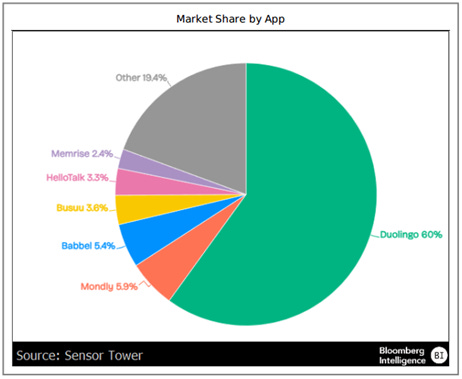
There are three tutor-based options for online language learning. These competitors offer stronger outcomes and personalization to suit each learner’s needs but have struggled with inconsistent teacher quality and vastly more expensive pay-as-you-go models that cost US$15-30/hour when Duolingo is free or $7-13/month.
The last group of competitors are AI-native businesses that have launched in the past 2-3 years and are trying to leverage LLMs to offer conversation-centric services and/or stronger engagement. One of these competitors has a free option (Talkpal), but typically prices are the same as Duolingo’s premium MAX option. These competitors are all early stage with user bases and datasets that are dwarfed by Duolingo. There do not appear to be any targeted language learning offerings from general-purpose AI companies at this time, and any success in self-taught learning on these platforms would be classified as edge cases, rather than a demonstrated trend.
While there are competitors that evidence greater capabilities in teaching students to a level of working proficiency or advanced levels, all these options require substantially more financial resources and/or higher levels of student diligence. In other words, the combination of gamification, convenience, and low pricing is substantially differentiated from all the Company’s competitors and is further augmented by a strong financial position. Furthermore, the addition of new subjects on Duolingo’s app presents a new point of competitive differentiation that is not replicated by any of its peers.
To the discussion on competition, I compared the app store rankings of Duolingo and all its major peers from a year ago to the most recent data to understand the relative changes in competitive positioning. This analysis indicated that Duolingo has retained its #1 position on both the Apple and Google app stores for the past year. However, there have been important shifts occurring below this level. Most notably, Praktika, and Talkpal have become the #2 and #3 highest ranked education apps over the past year, after starting without any quantified position. The success of these AI-native entrants has come at the expense of app-based peers, tutor-based options, and legacy learning providers. While this rise is remarkable and certainly worth monitoring, there is still a gap between Duolingo and these players, as Praktika, ranks between #8-20 overall, while Talkpal ranks #12-30 overall.
Moat Outlook
In assessing the trajectory of Duolingo’s competitive moat, I conclude that the Company’s advantage is growing at this time. For example, AI has materially increased the Company’s product development rate, with DUOL introducing 150 new language courses in one quarter. In addition, the launch of various non-language courses substantially increases the value proposition of Duolingo’s app as it provides additional features that other pure-play language learning competitors can’t compete on, regardless of learning format. Lastly, the overarching criticism of Duolingo has consistently been that the platform is engaging and helpful, but only for beginners, with practical proficiency the realm of more traditional players like Rossetta Stone. However, this gap has reduced with DET’s acceptance credentials, as well as the platform teaching up to a B2/knowledge job working proficiency level for three languages (English, Spanish, and French), with a stated aim to provide this level of content for the top nine languages on the app.
Strategy & Risks
Looking forward, Duolingo has two major initiatives that are intended to support the Company’s growth: 1) building the service into the default choice for language learning, and 2) expansion into new learning verticals.
As noted in the Competitive Moat section of this memo, a recurring theme in the competitive position of Duolingo’s app that is reiterated by user reviews across various platforms is the lack of content and efficacy for teaching users to working proficiency and advanced levels. Consequently, the Company is perceived as an entry-level option that users begin their language learning journey on before transitioning to more structured and intensive solutions, leading to an addressable market that is a subset of the broader language learning opportunity that is estimated at 2 billion learners and $60-80B annually. Expanding Duolingo’s product capabilities into advanced content is a critical enabler for the Company to gain exposure to the segment of the market associated with higher pricing and users with stronger intent, and would also close the only material gap in the firm’s competitive position.
Fortunately, management is attuned to this need, evidenced by the recent announcement that English, French, and Spanish are now taught to a CEFR B2 equivalent, and plans to reach this level for the top 9 languages on the app. Management has commented that English learning typically represents 80% of global language learners, while English is only learned by 50% of users on the Duolingo app, providing an example of the unmet market opportunity as well as a KPI to track the progress of Duolingo’s advanced learning capability. The deployment of AI at the Company augments these efforts as well with the ability to increase the rate of new course development, and through the video call feature (launched in Q3 2024) that is still early days but a significant new capability for users learning conversational skills.
Duolingo’s expansion into new learning categories is both defensive and offensive. It’s defensive, as new courses increase the retention of existing users through a higher value proposition, while it’s offensive by opening up the Company to a broader total addressable market (“TAM”) and prospective user base. For example, the global K-12 population learning math is estimated at 1.5-1.8 billion users, of which 800M-1B can be reached digitally. For music, 500m+ people have tried learning an instrument, while chess has 600m global players, of which 100-200m are active learners. The net benefit is an expansion of the Company’s TAM from $60-80B to a figure closer to the $150-300B estimated for education technology globally. However, rather than adding all of the potential user bases together to arrive at a total opportunity set for Duolingo, I believe it’s better to think about the additional categories as increasing the probability and penetration rate of the potential 2 billion language learners that DUOL is chasing. As a result, 1 billion users appears to be a conservative estimate of the total opportunity set to measure the Company’s MAU base as a measure of market adoption. In the medium term, management has laid out a target of 100 million DAUs in 2028, a figure that corresponds to 250 million MAUs at current engagement levels.
In contrast to the opportunities in front of Duolingo, the Company is facing two headwinds, both of which have arisen with the advent of generative AI. The first of these threats is the emergence of new competitors in the language learning market that use the technology to teach languages in a more effective and engaging manner, and potentially iterate at a higher speed than Duolingo. Importantly, this risk has already emerged in the form of Talkpal and Praktika, two competitors that offer AI-based conversation tools at prices comparable to Duolingo. Currently, both provide free-form conversation with higher sophistication that is more suitable for advanced learners to practice with, but offer shallower content, and less engagement while lacking the ability to teach beginners, positioning both as supplemental tools rather than full replacements of Duolingo. As a result, the Company’s future success will depend on its ability to provide unstructured AI conversation tools that build on its existing product, before these new entrants can develop an offering that can take users from beginner to advanced.
The other risk relating to AI that has come on the radar of investors is an expectation that the demand for language learning will decrease due to real-time translation services powered by LLMs. On this risk, I think the market’s understanding of Duolingo is completely backwards and therefore incorrect. This mistake stems from an investor community that predominantly speaks English natively, and views language learning as non-essential. However, as noted elsewhere, 80% of global language learners are learning English, based on a motivation to improve their economic situations either through education or immigration. As a result, learning English to a working proficiency is an unavoidable necessity for most language learners, and therefore not impacted by AI language tools. Importantly, Duolingo’s financials results already reflect this reality, with ex-US revenues at 62% of total in FY 2025, and that share has been increasing from 46% in 2022. Management has also noted that Google Translate has been available for a decade, and the Company has seen no discernable change in demand for language learning.
Management & Execution Capabilities
As noted in the Business Summary section of this memo, Duolingo was co-founded by its current CEO and CTO, Luis von Ahn and Severin Hacker. Luis is originally from Guatemala and was heavily influenced by his experience of having to pay $1,200 to travel to El Salvador and take the TOEFL test when he was applying to study in the US. Luis ultimately attended Duke University, where he received a Bachelor of Science in Mathematics, followed by earning his PhD in Computer Science at Carnegie Mellon University.
Luis’ first commercial venture was developing CAPTCHAs, computer-generated tests that filter human website users from automated bots. Luis worked on this technology alongside Manuel Blum, and ultimately sold the company, reCAPTCHA, to Google in 2009. Subsequent to this exit, Luis started Duolingo with Severin to increase the accessibility of language learning.
Since its founding, Duolingo has pursued a distinct path. When initially raising the Company’s seed round, the founders turned down funding from venture capital firms that made their investments contingent on relocating to Silicon Valley, instead preferring to build in their hometown of Pittsburgh, where they could avoid chasing the trends that dominate Silicon Valley and develop a distinctive culture. As a result, Duolingo has developed a culture with a mission orientation where employees have a “very strong sense of social responsibility and are interested in solving hard problems of the benefit of humanity”. This organizational focus is augmented by several principles: taking a long-term perspective, developing world-class quality solutions, moving with urgency, basing decisions on data and measurable impact, and having fun. After intentionally avoiding Silicon Valley at the seed stage, Duolingo subsequently raised several venture capital rounds (up to Series H) from top tier funds in the Bay Area, including two rounds led by Google Capital, likely helped by Luis’ exit to the firm before founding Duolingo. Recently, the Company’s CFO, Matt Skaruppa stepped down after serving a fixed term that was scheduled to end after Matt helped bring Duolingo public. Matt was replaced by Gillian Munson, who has served on the board since 2019, and was formerly the CFO of Vimeo, as well as a venture partner and managing director of investment banking.
Duolingo’s compensation structure is extremely simple and generally aligned with shareholder interests. For all executive officers except the CEO, fixed salary averages 19% of total pay, while at risk, equity-based pay is 81% of total pay; DUOL does not pay any short-term cash bonuses to any of its employees. At risk pay consists entirely of RSUs granted at market value that vest equally over four years. Outside of these executives, the CEO receives a fixed base salary of $750K per year, with no raises over the past three years. In addition, Luis was the recipient of a PSU-based pay package after the Company’s IPO. This package allowed Luis to receive up to 1.2 million Class A shares if DUOL’s share price reached certain levels and the service criteria was met. To-date, the performance of Duolingo’s shares has resulted in Luis achieving 65% of the total compensation available under the program. To receive the remaining payment, the Company’s shares would need to hit $612, and $816 by 2031, with the majority of the remaining compensated weighted to achieving the higher stock price target. A program design that awards a higher proportion of shares to larger stock price targets aligns this program with shareholder interests in my view.
Beyond compensation, the management team also holds a material economic interest in the Company, with over 15% of total shares outstanding held by current and former executives based on data from the 2024 proxy statement. Of this interest, the majority (14.5% of total shares) is held by Luis and Severin.
Governance & Shareholder Alignment
Duolingo’s board of directors holds shares that represent around 0.4% of the outstanding shares of the Company, a relatively minor interest compared to those of the management team. At the same time, eight of the ten board seats are held by independent directors. Board members are in three groups, with staggered re-election dates of 2026, 2027, and 2028. Four board members are up for re-election in 2026, of which one, Gillian Munson, is now the CFO of the Company. Duolingo’s board possesses a diverse mix of operating, leadership and investing experience across venture capital, gaming, web browsers, online software platforms, social networks and impact investing. I believe the board’s experience is well suited to the needs of Duolingo’s business. Board members are paid a base annual cash retainer of $35K per year, an annual grant of RSUs valued at $180K that vests one year after the grant date, and an initial grant of $360K in RSUs upon joining the board, vesting over three years. I would prefer longer vesting dates or obligations to hold awarded stock for board members, but the current structure is (unfortunately) pretty standard for the public companies that I’ve seen.
In terms of company governance, the shares held by the founders are Class B shares that have 20:1 voting rights in comparison to Class A shares, giving Luis and Severin an aggregate voting interest that exceeds 75%, thereby handing the founders control of the Company. However, when transferred to a third party, these Class B shares automatically convert to Class A shares. On a combined basis, Luis and Severin are the largest shareholders of Duolingo, so there is some justification for the disproportionate voting interest.
Value Dislocation Drivers
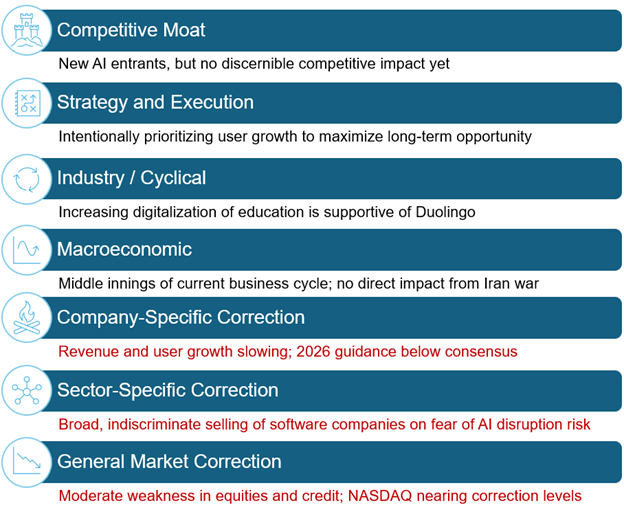
Duolingo IPO’d in 2021 at $102/share, only to get caught up in the market carnage that accompanied the Fed rate hike cycle in 2022. After these market pressures eased, DUOL’s stock went on a tear, rising from $70 at the beginning of 2023 to reach almost $530 in Q2 2025. Supporting this rise were extremely strong metrics in user, subscriber, booking, and revenue growth, accompanied by the Company achieving adjusted EBITDA margins of almost 30% after going public as an unprofitable business. These financial metrics were supported by bullish market narratives tied to Duolingo’s fast user growth, rising conversion of subscribers, the launch of a premium subscription tier, margin expansion, viral brand marketing, AI-enabled production innovation, and a transition from language app to learning platform, factors that combined to imply that the Company had an endless runway of monetization, and caused investors to bid up DUOL’s valuation to over 80x forward EBITDA.
The euphoric bullishness began to reverse after DUOL reported Q3 2025 earnings, as management shifted their emphasis to prioritizing user growth over short-term subscriber monetization, while investing in better learning efficacy and other long-term initiatives that would pressure profitability. The stock has thus swung violently from a bull case that assumed everything was up and to the right, to a bear case that can only see the growth deceleration and margin deterioration as indicative of a business that faces insurmountable competitive risks from AI-based competition and a growth engine that has permanently shifted lower.
In addition to the company-specific concerns that have driven the stock lower, Duolingo has also seen additional weakness from the market painting the business as a loser to AI disruption alongside other software enterprises, as evidenced by the stock closing down almost 10% the same day that T-Mobile announced live translation services on its cellular network. While the company and sector specific headwinds have had the largest impact on the Company’s stock price, Duolingo has also seen additional pressure from the general market selloff that has coincided with the war in Iran. The combined effect of these various factors is a stock that now trades at roughly 10x forward EBITDA.
The Company consequently finds itself in a situation where a rapid growth period has been interrupted by a pause where the next phase of growth requires patience as current initiatives lay the groundwork for the next chapter. Future returns based on multiple expansion in Duolingo’s stock will therefore be dependent on the Company reaccelerating growth and resuming margin expansion in 2027 and beyond. The Company’s management also has a history of announcing conservative guidance at the beginning of year, and then subsequently beating estimates and raising guidance as the year progresses. Given the extreme level of pessimism associated with a business that is expected to grow revenues at 15-18% at a 25% adjusted EBITDA margin, even a moderate decline in negative sentiment would be supportive of the stock in the short-term.
The various drivers of value dislocation drivers in Duolingo’s stock are summarized in the following graphic.
Financial Performance & Benchmarking
Duolingo’s business sits at the intersection of two categories of competitors: education-centric peers, and gaming companies. This section will therefore benchmark the Company against these two categories before discussing summary conclusions on the financial performance of the business relative to its competition.
Education Peers
To begin, I compare Duolingo’s revenues and gross margins as measured in US dollars in the following chart.
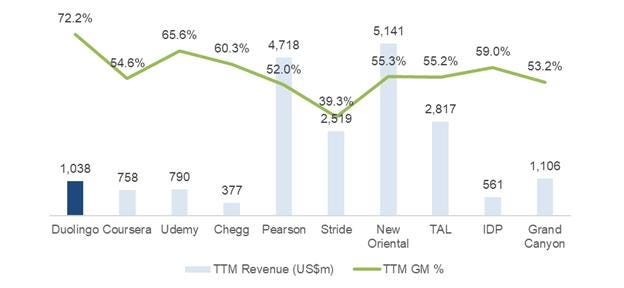
From an absolute revenue perspective, Duolingo is operating at a level similar to other online learning platforms like Coursera and Udemy, while substantially trailing traditional education heavyweights like Pearson (test development, administration, textbooks, and learning services), and New Oriental (the largest Chinese private education company with ~1,100 locations). Stride and TAL are other large peers, with the former providing K-12 and adult in-person learning services in the US, and the latter providing smart learning devices, primarily in China. Despite significantly trailing peers in revenue scale, Duolingo possesses a distinct advantage in gross margins, largely due to its app-based model that requires no distribution costs, and its catalogue of internally developed, proprietary content. In contrast, the Company’s competitors in the education sector group around two business models that structurally lower their margins. The first bucket are the education platforms that act as middlemen between learners and teachers or content providers. Among this group are Coursera, Udemy, and Chegg. All of these businesses must pay a percentage of revenue to their suppliers, leading to a cost base that tracks linearly with revenues. The second set of competitors operate businesses that primarily offer in-person learning and testing services that require paying for educators and physical premises that result in a higher fixed cost base. TAL does not fit either of these categories given its position as a product company, but its gross margins of 55% lag Duolingo’s because of its reliance on third-party suppliers to manufacture its devices. I now turn to discussing the relative operating profitability of the Company, a summary of which is in the graphic below.
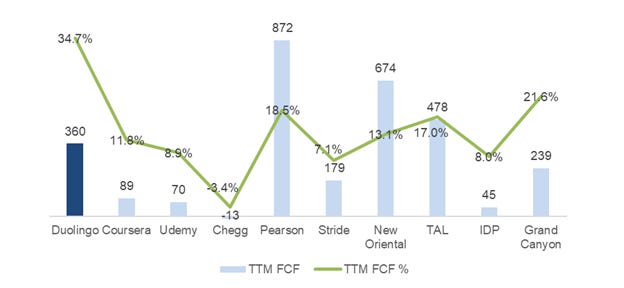
Important to note is this analysis is based on free cash flow as a percentage of revenue as a proxy for operating profitability as Duolingo relies on paying a large portion of total compensation in the form of RSUs that are expensed as stock-based compensation and therefore distort EBIT figures in Bloomberg data. With that caveat in mind, I observe that Duolingo’s gross margin advantage translates into a superior operating profit margin profile in comparison to all education peers. Interestingly, all of Duolingo’s marketplace competitors have structurally higher operating expenses as a result of greater reliance on external marketing to drive growth, evidencing Duolingo’s core competency in viral, social media-based marketing. Duolingo’s fixed cash operating expenses more closely align with scaled peers in traditional in-person education like Pearson, and Stride, suggesting a higher level of operational efficiency for its relative size, even after accounting for the R&D investments needed for the Company’s app.
To conclude the benchmarking of Duolingo with this segment of competition, I provide an overview of valuations across the comp set as well as a comparison of net debt levels.
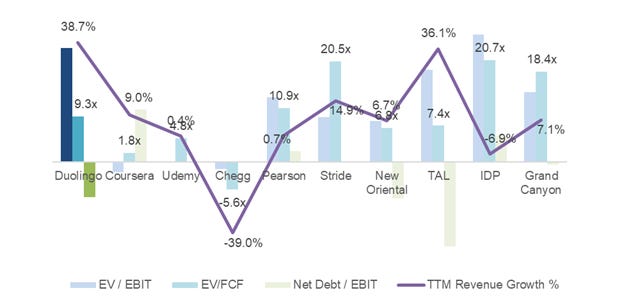
From the above chart, it’s clear that most players in the space have healthy balance sheets, evidenced by net cash positions, or debt levels that are low relative to earnings. The only exceptions worth noting are Pearson at Net Debt / EBIT of 2.1x (generally manageable), and IDP at 5.3x (does not leave much room for error). On an EV / EBIT basis, Duolingo appears expensive, trading at the top of the range with only IDP valued at a higher multiple. However, on a free cash flow basis, Duolingo’s EV / FCF multiple of 9.4x is in line with the mean, and one turn above the median, despite consensus revenue growth for 2026 that is 3x higher than the mean, and more than 2x higher than the median. In fact, only one peer, TAL has higher expected revenue growth for the next fiscal year. As a result, Duolingo’s valuation demonstrates a strong disconnect from its expected growth rate relative to education peers, a fact that is even more pronounced when Duolingo’s growth is positioned as a bridge year before a return to a faster rate of expansion.
Gaming Peers
In general, Duolingo’s financial profile is much more consistent with its gaming competitors than its education peers. A comparison of revenues and gross margins for the group is provided below.
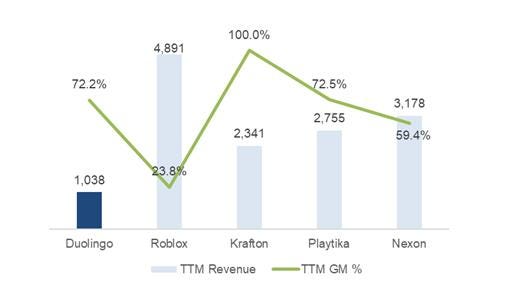
From these figures, its evident that Duolingo has class-leading gross margins, although these margins are more normal in the gaming industry where content is largely proprietary and self-developed. The exception of course is Roblox, who relies on a developer community to produce games on its platform, resulting in royalty payments to these creators, and structurally lower gross margins; Roblox’ margins are also weighed down by heavier infrastructure / compute costs relative to Duolingo. Krafton does not provide COGS in its accounting so its gross margin can be ignored. Playtika offers social casino and casual games that are simpler from a development perspective than more immersive games. At the same time, Playtika drives payments through its own proprietary channel, lowering its COGS, an observation that suggests underlying COGS (ex-payment processing) are lower at Duolingo given the Company’s current reliance on app stores to process its payments, providing margin upside should DUOL decide to process its own payments. Nexon operates massive virtual world games that are continually updated to keep content fresh and localize content with the aim of retaining users. This constant reinvestment to drive engagement leads to gross margins that trail those of Duolingo. Next is a discussion of operating profitability (once again measured by free cash flow margins), with the peer group figures provided in the following graphic.
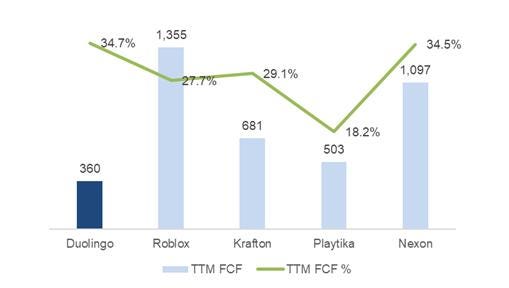
Once again, Duolingo leads the pack in terms of operating margins, a datapoint that is even more impressive given revenues that are more than 50% smaller than the next largest competitor. The Company achieves this superior profitability profile despite significant investments in R&D of almost 30% of revenue, bested only by Roblox at 32%. In terms of Sales & Marketing, Duolingo spends more than double the rate of Roblox as a proportion of revenue given the latter’s reliance on its creators to drive usage. Krafton also has a low investment rate in S&M as its franchise game, PUBG, is one of the most popular games in the world, requiring minimal investment in marketing. Playtika stands out in terms of S&M spending, a fact that appears consistent with a portfolio of casino and casual games that are highly competitive and low retention. Nexon spends a lower amount on S&M than Duolingo as well, a reality that reflects a mature game portfolio (some franchises are a decade or older) and user base. In terms of G&A, Duolingo is the second most efficient spender of overhead, with only Roblox the more efficient, reflecting the scale benefit of operating at revenues that are almost 5x large than Duolingo’s. Finally, an overview of net debt and valuation levels, with the context of TTM revenue growth is provided below.
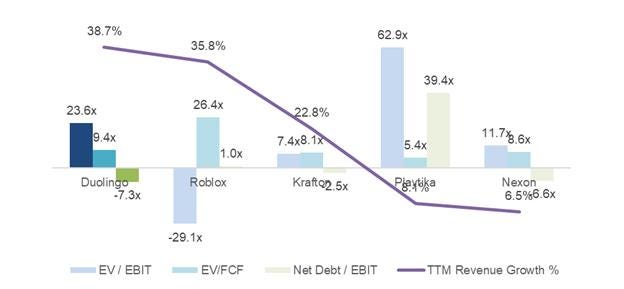
All competitors operate with net cash levels on their balance sheets, with the exception of Playtika. While Playtika’s net debt is high relative to EBIT, it’s manageable in comparison to free cash flow (less than 3.4x). EV / EBIT is less useful as a metric with this peer group given high reliance on stock-base compensation across the sector. On a free cash flow basis, Duolingo’s valuation is slightly above the median, and slightly below the mean, although these figures are skewed by Roblox’s valuation that is more than 2.5x higher than Duolingo’s, and is also the next highest valuation. While Duolingo’s growth exceeds that of Roblox on a TTM basis, Duolingo’s revenue growth for 2026 is expected to lag Roblox and Krafton. Given this context, Duolingo’s current valuation multiple appears fair, and its multiple premium relative to Krafton is justified based on superior margins and US listing (rather than Korea) even though 2026 revenue growth is lower.
In reviewing this data, Duolingo demonstrates superior gross and operating profitability to both education and gaming peers, despite operating at revenue levels that are much lower scale than larger competitors. From a valuation perspective, the Company’s valuation is a significant discount to education competitors, despite possessing stronger expected revenue growth and profitability, and appears broadly in line with valuations seen in the gaming sector. The gaming industry is well known for its reliance on major franchises that are often volatile. As a result, Duolingo’s ability to demonstrate staying power with its franchise as well as a return to growth would justify a higher multiple relative to gaming peers.
Forecasts, Valuation & Expected Returns
Duolingo possesses a differentiated competitive position that is evidenced by a class-leading growth and profitability profile. The question now becomes whether the current price of the business offers a sufficient return to investors given its prospects. To answer this question, I forecasted DAUs, subscribers, revenues and the various expense lines across three different scenarios. My forecasts for 2026 align with the guidance that management provided for the year, while noting that management consistently beats its initial guidance that it releases along with full year results. Management also provided a few medium-term targets for the business when they discussed FY25 results in March 2026. From this discussion, the Company stated their targets for 2028 are 100 million DAUs, with up to $2.5 billion of revenues and $700 million of adjusted EBITDA. These figures are provided for context in discussing the various forecast scenarios.
Base case
Revenues grow 16.6% in 2026, while EBITDA margins step down from 26.3% in 2025 to 23% in 2026. After this transition year, DAUs grow at a 20% CAGR to 2031, reaching 91 million in 2028, and 157 million in the terminal year. Subscribers grow at a similar rate (although as a % of DAU, subs are lower in 2031 than in 2025), while price per subscriber is flat over the forecast period. Revenues grow in line with DAUs and subs, while EBIT margins expand from 23% in 2026 to 24.4% in 2031, but are lower than 2025 (26.3%). Margin expansion is driven by economies of scale on G&A spending that falls from 13% of revenue in 2025 to 10% in 2031. Gross margins are not assumed to recover to prior levels (68.5% vs. 72-73% seen in the past few years) due to higher AI compute costs and higher amortization from investments in intangible assets.
Weak case
Revenues grow 15% in 2026, with EBIT margins at the same level as the base case. DAUs and subs grow at 13% CAGR to 2031, with DAUs hitting 78 million in 2028, and 111 million in 2031. Revenues grow faster (15%) than DAUs and subs as a higher percentage of bookings convert to revenues when growth slows down (bookings reflect the up-front payment of a 12-month subscription, while revenues are recognized equally over 12 months; as subscription growth declines, revenues will more closely track bookings). EBIT margins deteriorate to 14% in 2031 due to higher spending on AI compute that is not offset by pricing increases, a 350bps increase in R&D as a percent of revenue to maintain engagement and a product feature advantage, and an increase in sales and marketing spend to 13.3% of revenues, to reflect a more competitive environment to attract users.
Best case
Revenues grow 18% in 2026, but EBIT margins are the same as the base and weak cases, reflecting the growth investments that management has prioritized for the year. DAUs and subs grow at roughly 25% compound to 2031, reaching 101 million (in line with management’s 2028 target), and 197 million in 2031. Both figures are still a fraction of the 1.5 – 2 billion global language learner market. Revenues grow 30% annually to 2031 as ARPU increases 5% in 2027 and 2028, followed by 2.5% growth from 2029-31. EBIT margins expand almost 300bps from 2025 levels based on higher efficiency on compute costs (GM of 70% in 2031 vs. 69% in 2026), mild reductions in relative R&D and S&M spend compared to 2025 levels, and material G&A efficiencies (from ~13% in 2025 to 9% in 2031).
Valuation & Expected Return
In comparison to the valuation benchmarking provided in the prior section of this memo that was based on Bloomberg figures, the current price of Duolingo shares result in an EV / EBIT multiple of ~12.5x based on my calculation for 2025 EBIT. High quality education competitors trade around 20x FCF, which is a good proxy for EBIT when applying an exit multiple, while the most attractive growth story in gaming (Roblox) trades at over 25x. For this reason, I believe 20x is a reasonable exit multiple when calculating my expected return. Said another way, I think the current pessimism does not reflect the long-term valuation multiple that typically applies to a business with similar profitability metrics and growth rates. As a result of these assumptions, and a closing price of $98.57 on March 31, 2026, my range of expected returns is provided in the following table.
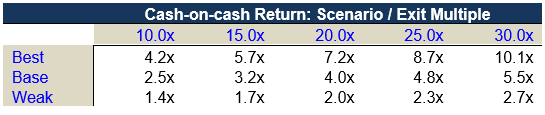
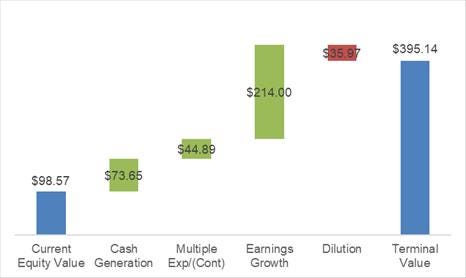
From this sensitivity analysis, I arrive at a base case return of 4x cash-on-cash, or 27.3% compounded until 2031, with these figures implying a margin of safety close to 80%. Perhaps more significantly, even when assuming an exit multiple of 10x EBIT on the base case (a valuation even lower than the present), I can still expect a 2.5x cash-on-cash return, while applying the same bear case multiple to the weak case yields a 1.4x return. This lower bound is noteworthy as the market is currently pricing Duolingo as if terminal margins will be more than 1000 bps lower than the latest fiscal year while assuming the long-term growth rate is less than 7% and a terminal multiple (10x) that is even lower than present 12.5x. This analysis strongly suggests that the market’s excessive negativity has caused Duolingo to trade far below fair value, positioning the stock for exceptional long-term returns. To conclude this section, I provide a breakdown of the components of expected return in the following chart.
Investment Failure Modes
To conclude, I explore the various conditions that, if true, would no longer justify Duolingo continuing as a holding in my portfolio. I also discuss the metrics I will be tracking to determine if these nullifying assumptions have been met.
1) User and revenue growth does not re-accelerate
If user growth and/or revenue growth do not re-accelerate in 2027 and beyond, then the assumption that 2026 was merely a pause in a longer-lasting, high-growth phase is not true. Consequently, the Company’s business will have fundamentally reset to a growth rate in the low teens or slower, suggesting a lower valuation multiple for the business than what was assumed in my expected return analysis. Clearly, MAU, DAU, subscriber and revenue growth metrics will be monitored to evaluate this potential outcome. At the same time, I will be paying close attention on earnings calls to management’s excitement or lack thereof from the traction they’re seeing on current growth initiatives. If management starts speaking with greater clarity on accelerating engagement or user growth, this will be thesis confirming, as would updates to guidance that exceed what’s been previously communicated to the market. Hearing the opposite from management would increase the likelihood of this scenario occurring.
2) Competitors leverage AI to create solutions that support the entire learning journey with engagement comparable to Duolingo
Large language models incorporate substantial datasets on learning curriculum and teaching methods at launch that could potentially neutralize Duolingo’s existing advantage from its own dataset. This fact, combined with existing AI-native competitors’ strength in open-ended conversation tools, suggests there’s a window where peers could more quickly develop solutions that target beginner-level learners before Duolingo can capture intermediate and advanced learners. Should competitors achieve this outcome with a solution that offers comparable engagement to DUOL, the Company’s competitive advantage would evaporate. The best metric to track this development will be the app store rankings of competing language learning apps and any observed link with Duolingo’s core financial metrics.
3) Duolingo loses its structural advantage in engagement, leading to a sustained decline in associated metrics
Related to the prior point is a potential loss of Duolingo’s core differentiation of providing engaging learning solutions. The loss of this advantage would cut two ways: 1) the Company would struggle to attract new users and convert subscribers, and 2) Duolingo would lose existing users and subscribers to alternatives. The Company itself states that DAUs are the best metric for measuring engagement, and therefore I will be measuring the proportion of DAUs to MAUs over time. If this ratio decreased consistently for four quarters or more, that would suggest a decline in engagement on the app. A fall in this engagement metric coinciding with a stall in MAU and/or DAU growth would strongly indicate a loss of competitive position.
4) Duolingo ceases to be the default choice for beginning the language learning journey, thereby losing its top-of-funnel advantage
An implicit assumption of Duolingo’s competitive position is that capturing the largest number of users at the start of the language learning process results in the highest LTV, as Duolingo can spend more time with these users, leading to more opportunities to convert users to paid subscribers or monetize through ads. Put differently, all of Duolingo’s efforts to increase their value proposition to users through advanced content, external certifications, and proven efficacy are contingent upon their ability to attract and retain a sufficient number of entry-level users. As a result, Duolingo’s monetization engine breaks down if the Company is no longer the first choice for prospective learners. For this reason, tracking MAU growth is relevant, as it signals the total number of users joining the app, and therefore can serve as a proxy for how successful DUOL is at capturing the new users that are the forward indictor of future monetization.
Great article
Not one for me but best of luck, very thorough write up.